
Understanding Bitcoin Custody and Ownership: Choosing The Right Approach for You
Bitcoin redefines what it means to own an asset in the digital age. Unlike traditional investments, you can hold Bitcoin directly, outside the banking system. With that freedom comes responsibility and choice: how you secure, title, and pass on your Bitcoin safely.
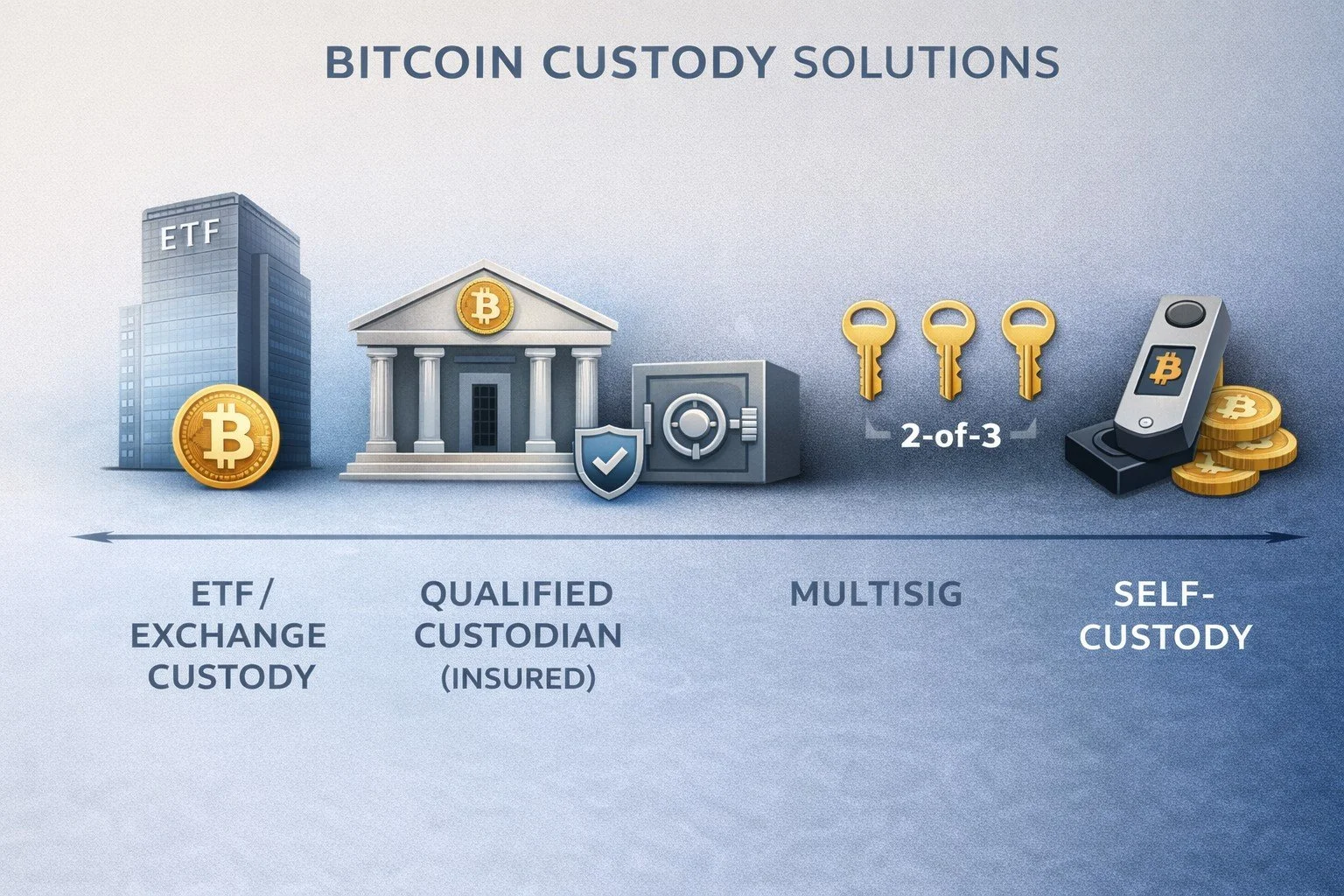
Below, we outline the major custody paths and the trade-offs of each, focusing on security, control, and estate-planning considerations.
Bitcoin ETFs: Familiar, Accessible, and Estate-Friendly
For clients who want Bitcoin exposure without managing private keys, Bitcoin ETFs offer a regulated and operationally simple option. They integrate seamlessly with brokerage accounts, retirement plans, portfolio reporting, and existing compliance frameworks.
One practical advantage of ETFs is liquidity and credit access. ETFs are treated like other marketable securities, making margin lending and portfolio lines of credit straightforward for many clients.
The trade-off is ownership. ETF investors do not control private keys and cannot self-verify Bitcoin holdings on the network.
From an estate-planning standpoint, ETFs are often the simplest option. Beneficiary designations, trust ownership, step-up rules, and account transfers follow well-established processes. For families prioritizing ease of inheritance and administrative clarity, ETFs can play a meaningful role, even alongside self-custodied Bitcoin.
Self-Custody and Hybrid Self-Custody: Freedom, Flexibility, and Responsibility
Bitcoin custody ultimately comes down to who controls the private keys.
What Are Private Keys?
In simple terms, a private key is a digital signature, a secret code that proves ownership of Bitcoin and authorizes transactions. A public key, or Bitcoin address, functions like an account number that can be shared to receive funds. Whoever controls the private key controls the Bitcoin.
This is what makes Bitcoin fundamentally different from most traditional financial assets. Ownership is determined by cryptographic control, not by account registration or institutional records. How keys are stored and protected defines the custody model.
Within self-custody, several setups exist, ranging from complete independence to professionally assisted structures. Each has distinct benefits and risks.
Single-Signature Self-Custody
A single private key controls access to the Bitcoin. This is the simplest form of self-custody and can be appropriate for smaller balances or users who prioritize autonomy and minimal setup.
Trade-offs: Simplicity versus single-point-of-failure risk.
If the private key or seed phrase is lost, access to the Bitcoin is lost. While some modern wallets offer encrypted backups, social recovery, or guided restoration tools, the risk of permanent loss still exists.
Single-signature setups are also more vulnerable to coercion and theft. If a seed phrase is discovered, copied, or physically taken from the owner, an attacker can move the Bitcoin without restriction.
For these reasons, we generally do not recommend holding large amounts of Bitcoin in a single-signature setup.
From an estate-planning perspective, single-signature custody requires extremely careful documentation and communication. If heirs cannot locate or reconstruct the key material, assets may be lost permanently. There is no default recovery mechanism.
Multi-Signature Self-Custody
Multi-signature setups require multiple keys to authorize transactions, most commonly two of three keys. All keys are held by the owner, typically stored in separate physical locations or devices.
Trade-offs: Substantially improved security and redundancy versus a moderately higher setup complexity.
This model eliminates a single point of failure. A lost key does not result in loss of funds, and theft of one key alone is insufficient to move Bitcoin. Privacy and sovereignty remain intact, with no third-party involvement required.
For estate planning, multisig offers meaningful advantages. Keys can be distributed across trusted locations, vaults, and estate documents, allowing heirs to assemble the required quorum without exposing full control during life. When properly structured, multi-sig can reduce both loss and coercion risk.
Multi-Signature With Collaborative or Professional Key Holding
In this hybrid model, one or more keys are held by a professional partner while the client retains control of the remaining keys. No single party can move funds independently.
Trade-offs: Improved recoverability and estate integration versus limited reliance on a trusted counterparty.
This structure is increasingly common among high-net-worth families, trusts, and business owners. It allows for strong security while introducing recovery workflows, continuity planning, and institutional processes that are difficult to replicate independently.
From an estate-planning standpoint, collaborative multi-sig can be very effective. A professional key holder can coordinate with executors, trustees, and legal counsel, helping ensure assets are transferred correctly without giving up unilateral control during life.
Insured Qualified Custody: Institutional Security With Bitcoin-Native Design
A newer category of Bitcoin custody blends institutional safeguards with Bitcoin-native architecture. Insured custodians such as AnchorWatch offer regulated custody paired with commercial insurance coverage against theft, loss, or internal failure.
This approach can be appropriate for clients who want reduced operational responsibility while maintaining direct Bitcoin exposure. Assets are typically held in segregated accounts, often using multisignature structures with insurance underwriting layered on top.
Trade-offs: professional oversight and insurance protection versus reduced sovereignty and higher costs.
From an estate-planning perspective, insured custodians can simplify administration. Accounts can be titled to trusts or entities, beneficiaries can be clearly designated, and transfer processes resemble familiar custodial workflows. For some families, this strikes an effective balance between control and institutional support.
Leaving Bitcoin on an Exchange: Convenience at a Cost
Holding Bitcoin on an exchange may feel convenient until it isn’t. Exchanges are frequent targets for hacks, may freeze withdrawals, and often provide limited transparency into custody practices. Account lockouts and operational failures are well documented.
Most exchanges are poorly suited for estate planning. Many cannot title accounts to trusts or accommodate beneficiary designations, which can significantly complicate wealth transfer.
If exchange custody is used at all, we recommend Bitcoin-only platforms and treating the account as temporary storage rather than long-term custody.
The Citrine Lens
Bitcoin ownership exists on a spectrum, from fully sovereign self-custody to regulated ETF exposure. There is no universally correct approach. The right structure depends on security tolerance, technical comfort, estate objectives, and long-term intent.
At Citrine Capital, we help clients integrate Bitcoin into broader wealth management, tax planning, and estate strategies. Whether through multi-signature self-custody, insured custody, ETFs, or a blended approach, our focus is on deliberate ownership, strong security, and a clear plan for legacy.
About The Author
Jirayr Kembikian, CFP® is a wealth advisor, managing director and co-founder of Citrine Capital, a San Francisco-based wealth management and tax preparation firm serving tech professionals, founders, and business owners. He specializes in navigating the complexities of equity compensation, private investments, and Bitcoin wealth strategies. With over a decade of experience guiding clients through liquidity events and complex financial decisions, Jirayr brings a grounded yet forward-thinking perspective to building and preserving wealth.