
AI and Bitcoin: How the AI Boom Is Strengthening Bitcoin
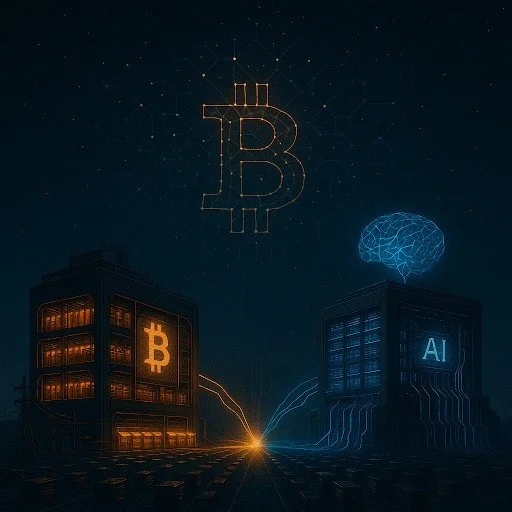
Artificial intelligence is expanding at a rate that few technologies in history have matched. The world’s largest companies - OpenAI, Google, Meta, NVIDIA, Anthropic, and Tesla - are pouring billions into compute, search algorithms, LLMs, autonomous systems, and agentic AI. Every new model requires more computing power, more datacenters, and more energy.
At the same time, Bitcoin has moved far beyond its early experimental stage. Custody options have broadened, institutional adoption continues to grow, and Bitcoin miners have become one of the largest grid participants in the world.
Most view AI and Bitcoin as separate revolutions, but a different story emerges when you look closer. Their trajectories are already intersecting across energy markets, machine payments, and digital trust. The more advanced AI becomes, the more it depends on the systems and benefits Bitcoin provides.
AI’s Growing Hunger for Compute Will Reshape Global Energy Markets
Modern AI systems are not just improving. They are becoming far more compute-intensive, requiring massive new datacenter capacity and unprecedented levels of electricity. A recent U.S. Department of Energy report found that data-center electricity demand is projected to double or even triple again by 2028.
AI has a critical flaw: its power demand is inelastic. AI datacenters cannot turn off during peak load, cannot throttle back to stabilize the grid, and cannot pause when the sun is not shining or the wind is not blowing. They require stable, uninterrupted power. This creates volatility on modern grids, especially those increasingly dependent on intermittent renewables.
Enter Bitcoin mining. Unlike AI datacenters, Bitcoin miners are a perfectly flexible electrical load. They can power up or down in seconds. They monetize energy that would otherwise be wasted. They stabilize renewable-heavy grids by absorbing excess production that would otherwise be wasted, and shutting off instantly when power is needed elsewhere. This makes them the only large-scale, economically viable “shock absorber” capable of smoothing AI’s nonstop energy demand.
Imagine a town powered mostly by solar. On bright afternoons, the grid produces more electricity than the town can use, and much of the excess is wasted. Batteries can store some of this energy for later, but once they are full, additional power still has nowhere to go.
Now add two players:
an AI datacenter that needs constant power
a Bitcoin mine that can turn on or off instantly
On sunny days, Bitcoin miners consume the excess solar power and turn it into revenue, making the solar plant more profitable. At night, when the electrical grid tightens, Bitcoin miners shut off in seconds, freeing power and reducing the risk of shortages for both the AI datacenter and the surrounding community. No hospital, factory, or datacenter can behave this way. Only Bitcoin miners can.
AI datacenters require stable baseload power. They anchor demand. Bitcoin miners are the opposite - a fast, flexible load that monetizes peaks. Together, they exemplify a powerful form of energy synergy. AI consumes the baseline; Bitcoin mines the peaks.
As AI’s energy usage accelerates and renewable generation grows, grid volatility will increase. This volatility creates an urgent need for real-time flexible demand. Bitcoin miners fill this role uniquely, supporting further renewable and nuclear build-out while making energy markets more stable and more profitable. AI’s rise directly strengthens the energy-market case for Bitcoin.
Autonomous AI Agents Will Need Money. Bitcoin Is the Only Fit
The next major leap in artificial intelligence is not just smarter models. It is the rise of autonomous AI agents. These agents will not simply answer questions. They will act independently, making decisions, purchasing compute resources, initiating transactions, and interacting with the world without human intervention. Self-driving cars will pay for charging automatically. AI assistants will purchase data, APIs, or cloud compute on demand. Intelligent devices will coordinate with each other in real time. We are moving toward a machine-to-machine economy, and that economy requires a monetary system that machines can use natively.
Traditional financial infrastructure cannot support this shift. Most payment systems were designed for humans, not autonomous software. The legacy banking systems are slow, permissioned, and reversible. Payments often require human approval, operate only during business hours, or depend on jurisdiction-specific banking relationships. For an autonomous agent, uncertainty around settlement is a critical failure mode. A machine cannot reliably operate if its payments can be frozen, reversed, or delayed by compliance checks it cannot satisfy on its own.
This is where Bitcoin becomes indispensable. Bitcoin is digital bearer money that settles globally, operates continuously, and does not require intermediaries or approvals. Once a Bitcoin transaction is finalized, it cannot be undone. When paired with scaling layers like Lightning or tools like Nostr Wallet Connect, Bitcoin enables microtransactions, streaming payments, and API-per-request pricing at machine speed. These properties align naturally with how autonomous systems operate.
No other digital monetary system reliably meets these requirements. Stablecoins and bank-issued digital money remain custodial and reversible. High-throughput chains optimize for speed, smart-contract platforms optimize for programmability, and privacy coins optimize for confidentiality. Each makes tradeoffs that limit their suitability as a neutral, globally verifiable monetary layer for autonomous systems. Autonomous systems cannot depend on money that changes its rules or availability over time. Bitcoin remains unique in combining global accessibility, non-custodial ownership, predictable monetary rules, and final settlement without human approval.
AI agents will not adopt Bitcoin because Bitcoiners want them to. They will adopt it because it works under the constraints autonomous systems face. Machines cannot wait days for settlement, cannot tolerate arbitrary freezes, and cannot rely on fragmented banking infrastructure. They will converge on the system that allows instant, reliable, and permissionless value transfer across borders.
AI Will Break Trust; Bitcoin Will Restore It
AI-generated content is already nearly indistinguishable from human content. We now have deepfake audio, synthetic facial overlays, fabricated financial statements, simulated political speeches, and highly convincing AI-driven fraud. We are entering an era where seeing is no longer believing.
Society will need a way to prove what is real. We need an integrity layer that provides verifiable proof that something was created by a real person at a real moment in time and has not been tampered with. This is where the Bitcoin blockchain becomes essential.
The Bitcoin blockchain allows creators to anchor a piece of content by attaching a small digital fingerprint to it. Once this fingerprint is recorded on the Bitcoin blockchain, it becomes effectively immutable. The ledger is global, public, and cryptographically secured, allowing anyone to verify that the record has not been altered. If someone changes even a single pixel, the fingerprint no longer matches. In other words, the Bitcoin blockchain provides a mathematical way to verify authenticity.
Other blockchains can also record digital fingerprints, but Bitcoin is uniquely suited for this role. Its ledger is the most widely trusted, politically neutral, and resistant to change. There is no issuing authority, administrator, or governance body that can rewrite history. That makes Bitcoin the strongest possible reference point for long-term verification.
Here is a simple example. Imagine a politician records a short video message. Before releasing it, their team anchors a digital fingerprint of that video to the Bitcoin blockchain. Weeks later, a deepfake of the same politician begins circulating online. The public can compare both versions to the fingerprint stored on Bitcoin. The real video matches while the fake does not.
Importantly, anchoring content to Bitcoin does not involve storing large files on chain. Only a small cryptographic fingerprint is recorded, often batched with many others into a single transaction. This makes it a highly efficient use of block space that naturally adapts to Bitcoin’s fee market, rather than overwhelming it.
Authenticity does not depend on trusting an institution or government. It is verified by open, mathematical proofs that anyone can independently check.
The Future Is AI and Bitcoin
Most people still treat AI and Bitcoin as two separate technological forces, one focused on intelligence and automation, the other on money and energy. But they are interconnected systems, each amplifying the other.
Across every major domain where AI is reshaping the world, Bitcoin quietly solves the constraints AI creates:
AI drives massive new energy demand. Bitcoin monetizes and stabilizes that demand.
AI creates autonomous agents that need native digital cash. Bitcoin provides it.
AI floods the world with synthetic content. Bitcoin anchors authenticity and provenance.
Across energy, payments, and digital trust, the pattern is consistent. The more AI grows, the more essential Bitcoin becomes.
AI accelerates Bitcoin. Bitcoin stabilizes AI. And as both technologies compound, the trajectory becomes clearer. The more we build with AI, the more we will rely on Bitcoin as the monetary, energy, and trust layer beneath it.
This is one reason why, at Citrine, we view Bitcoin not as a trade, but as a monetary and technological network. We see it as an emerging global settlement layer that sits beneath energy markets, machine payments, and digital trust. As AI reshapes the economy, we believe prudent Bitcoin exposure allows clients to align with these structural shifts rather than remain fully dependent on systems that are increasingly fragile, permissioned, and centralized.
In technology, energy, economics, and geopolitics, all roads lead to Bitcoin.
About The Author
Jirayr Kembikian, CFP® is a wealth advisor, managing director and co-founder of Citrine Capital, a San Francisco-based wealth management and tax preparation firm serving tech professionals, founders, and business owners. He specializes in navigating the complexities of equity compensation, private investments, and Bitcoin wealth strategies. With over a decade of experience guiding clients through liquidity events and complex financial decisions, Jirayr brings a grounded yet forward-thinking perspective to building and preserving wealth.