
The Silicon Reserve: Securing Truth and Wealth in the Terawatt Era
In previous discussions about the shifting financial landscape, the focus has often been on the concept of hard assets. History demonstrates that world reserve currencies eventually struggle under the weight of their own debt. In response, Bitcoin has emerged as a scarce, digital alternative to the traditional cycle of currency debasement. It represents a shift from trust in institutions to trust in code and mathematics.
As 2026 progresses, a new pillar of wealth is forming at the intersection of energy, money, and intelligence. At the center of this shift is the recent SpaceX IPO, which was the largest public listing in history. While the headlines focus on launch cadences, the prospectus reveals the true driver of this value: a transition toward a Silicon Reserve strategy. This recognizes that physical infrastructure from the $55 billion Terafab alliance with Intel to SpaceX’s own integrated AI architecture is the ultimate hedge against both geopolitical and economic uncertainty. By bringing the entire chip-making supply chain back to domestic soil and eventually into orbit, builders are insulating themselves from the rising instability of the old world order. This full vertical integration, controlling everything from custom chip fabrication to final deployment, drastically accelerates infrastructure scaling. As hardware and model efficiencies advance simultaneously, this structural control expands profit margins across the entire AI ecosystem, enabling profitable growth even under capital constraints. This race for raw intelligence is matched by the physical anchor of the monetary ledger, where institutional Bitcoin miners are aggressively scaling the specialized hardware and power infrastructure that pushes network security to historic highs.
While an AI chip foundry and a Bitcoin mining operation may seem unrelated, a first-principles look reveals they are two sides of the same coin. Both are attempts to capture and verify value using the fundamental laws of physics. One creates the capacity to think, while the other creates the capacity to account for value. Together, they represent the foundation of the next industrial era.
The New Triple Point
For decades, the traditional 60/40 portfolio relied on the stability of traditional institutions. But in an era of rapid currency debasement, nominal paper gains are a dangerous illusion, masking the fact that actual purchasing power is falling. True diversification now requires moving toward assets anchored in the physical laws of thermodynamics. This new real-world infrastructure is defined by three universal currencies that drive the modern economy:
Joules (Energy): The raw power needed to do work. Without energy, no other economic activity can exist. In 2026, exploding demand from AI data centers is driving an unprecedented power crunch, and is forecasted to reach 1,350 TWh annually by 2030. This footprint rivals or surpasses the total energy consumption of many industrialized national economies.
Bitcoin (Money): This digital ledger is used to store and transfer the value of work. It is the first global money that can’t be manipulated by a central authority. With Bitcoin mining currently consuming roughly 150 TWh per year, it provides a unique and flexible benchmark for how energy can be converted into verifiable value.
Flops (Compute): The intelligence used to direct and optimize work. In an age of automation, processing power is as valuable as the energy used to power the machines.
This framework is the exact arbitrage driving the largest capital deployments of 2026. The ambition of the Terafab project brings these three points into focus. This $55 billion alliance, including Intel as a primary manufacturing partner, targets a staggering one terawatt of annual compute capacity. This represents the world's most aggressive attempt to convert joules into flops. With volume production targeted for 2027, the facility aims to produce between 100 billion and 200 billion custom AI and memory chips annually.
This strategy further accelerated with the May 2026 announcement of a massive compute partnership between SpaceX and Anthropic. In a move that signaled the end of compute tribalism, SpaceX agreed to lease the full capacity of its Colossus 1 supercomputer to its primary rival, Anthropic. This deal provides Anthropic with over 300 megawatts of immediate capacity, proving that in 2026, flops have become a more powerful diplomatic currency than competitive rivalry.
Similarly, enterprise-grade Bitcoin infrastructure is providing immediate financial validation for the Triple Point. Bitcoin miners have secured over $80 billion in AI and high-performance computing contracts. This partnership model is accelerating because traditional AI data center developments face massive delays and cancellations due to power grid bottlenecks and severe utility infrastructure backlogs. Because established Bitcoin mining facilities already possess energized sites, operational infrastructure, and legal grid connections, they offer a structural advantage that traditional infrastructure developers simply can’t match. This shift is clearly visible in recent corporate reports. In their Q1 2026 financial disclosures, Core Scientific reported that AI and HPC revenues skyrocketed to $77.5 million, officially overtaking Bitcoin mining as its primary business line. Meanwhile, TeraWulf confirmed that over 60% of its quarterly revenue is now driven by AI hosting. This shift proves the framework in action. The same physical infrastructure can toggle between monetizing joules as Bitcoin or as flops, depending on market conditions. For the modern investor, owning the Triple Point means controlling the foundational toll roads of the digital age. It is a direct stake in the raw physics and processing power that underpins the entire modern economy.
Bitcoin as the Economic Floor for Silicon
While the Triple Point explains the physics, the actual construction of these assets requires a new kind of financial resilience. Building a high-tech chip foundry takes years and billions of dollars in sunk costs before the first chip is sold. The semiconductor industry is also cyclical, with periods of high demand followed by market contractions. This is where the synergy between Bitcoin and flops becomes a financial game-changer.
Bitcoin mining is the only global industry that can buy electricity at any scale, at any time, in any location, and turn it off almost instantly. As Terafab builds its power-hungry facilities in Austin and beyond, it will inevitably face times of excess energy, grid constraints, or lower near-term demand for AI training. Bitcoin mining provides an immediate economic floor. Miners can absorb surplus joules during downturns or construction phases, helping the project remain cash-flow positive even before full AI utilization.
This symbiosis is playing out in the market today. AI workloads can generate dramatically higher revenue per kWh, with estimates around $25 equivalent versus roughly $1 for Bitcoin mining. While a superficial analysis might suggest mining is less productive than AI, revenue per kWh is an incomplete metric that ignores the reality of infrastructure risk. The $25 AI revenue is customer-dependent income; it depends on finding a customer and maintaining perfect uptime. The $1 Bitcoin revenue is permissionless wealth; it is a global, instant bid for energy that is available 24/7 with zero counterparty risk. In this sense, Bitcoin mining acts as the constant base load of revenue that justifies the massive upfront investment in power plants and foundries. It allows builders to overbuild or overbuy energy for future AI needs without the fear of carrying expensive, idle capacity.
The flexibility of miners allows them to take the residual or interruptible loads that AI can’t easily use, lowering the effective cost of new power projects. Many miners are already hybridizing by keeping Bitcoin mining as the flexible base layer while leasing capacity to AI under long-term contracts. This integration is scaling rapidly through behind-the-meter partnerships with renewable energy developers. By co-locating directly with wind, solar, and nuclear installations, miners act as virtual energy storage, absorbing intermittent oversupply to fund new clean power generation while securing a sustainable baseload for the adjacent AI facilities. Every joule that would have been wasted to curtailment is instead converted into Bitcoin. Real-world examples already show this dynamic. Miners routinely curtail their operations during peak demand, stabilizing the grid when it matters most. These are capabilities that rigid, always-on AI loads struggle to match. Bitcoin mining does not compete with the broader data center buildout. It de-risks it. It turns potential stranded energy into a reliable revenue stream, making terawatt-scale compute projects more sustainable in an uncertain environment.
This dynamic is already reaching the individual level through the rise of agentic compute marketplaces. Today, AI agents can autonomously buy stranded compute from personal devices around the world to train and run localized models. By renting out excess flops for Bitcoin, individuals are participating in the exact same thermodynamic trade as the Terafab. Whether at the scale of a planetary foundry or a home office, the strategy remains identical: monetizing the hardware that thinks and the hardware that counts.
The Orbital Frontier and Bypassing Terrestrial Constraints
While the hybrid pairing of Bitcoin and AI solves the economic risks of building infrastructure on Earth, it eventually runs into the hard physical limits of the terrestrial power grid. If the primary constraints for the Terafab model are local power access and heat dissipation, the logical conclusion is to scale the entire stack off-planet entirely. While managing heat in the vacuum of space presents a unique engineering hurdle, some designs are already solving this through advanced cooling strategies. We are already seeing the first steps of this transition with the April 2026 announcement of the Meta and Overview Energy partnership. This deal to beam 1 GW of solar power from orbit directly to Earth data centers proves that space is becoming a functional part of our energy infrastructure.
The SpaceX IPO is, at its core, a public offering for this Orbital Frontier. It is clear that Space-as-a-Service is evolving into Compute-as-a-Service. A significant portion of the $75 billion capital raise will fund expansion of AI compute infrastructure and plans for orbital AI compute. This transition is being further accelerated by the unprecedented incentives in Elon Musk’s newly revealed SpaceX compensation package. According to recent filings, Musk is eligible for over 60 million shares if SpaceX successfully deploys orbital data centers with at least 100 terawatts of compute capacity. This is a direct financial mandate to move the world's most intensive "flops" into space, where cooling is infinite and solar energy is constant.
This macro shift is entirely enabled by a structural collapse in space transport costs. SpaceX has compressed the cost to deliver mass to orbit by roughly 95 percent, and the scaling of a fully reusable Starship is projected to slash those costs even further, unlocking the physical and economic viability of space-based data centers. The strategic driver behind this move is not just cost efficiency, but raw speed to market. Constructing gigawatt-scale data centers on Earth requires billions in upfront facility costs and years of bureaucratic grid approvals. Bypassing terrestrial grid constraints entirely by launching mass-manufactured compute pods allows builders to deploy infrastructure in months rather than years, making immediate availability the ultimate competitive moat.
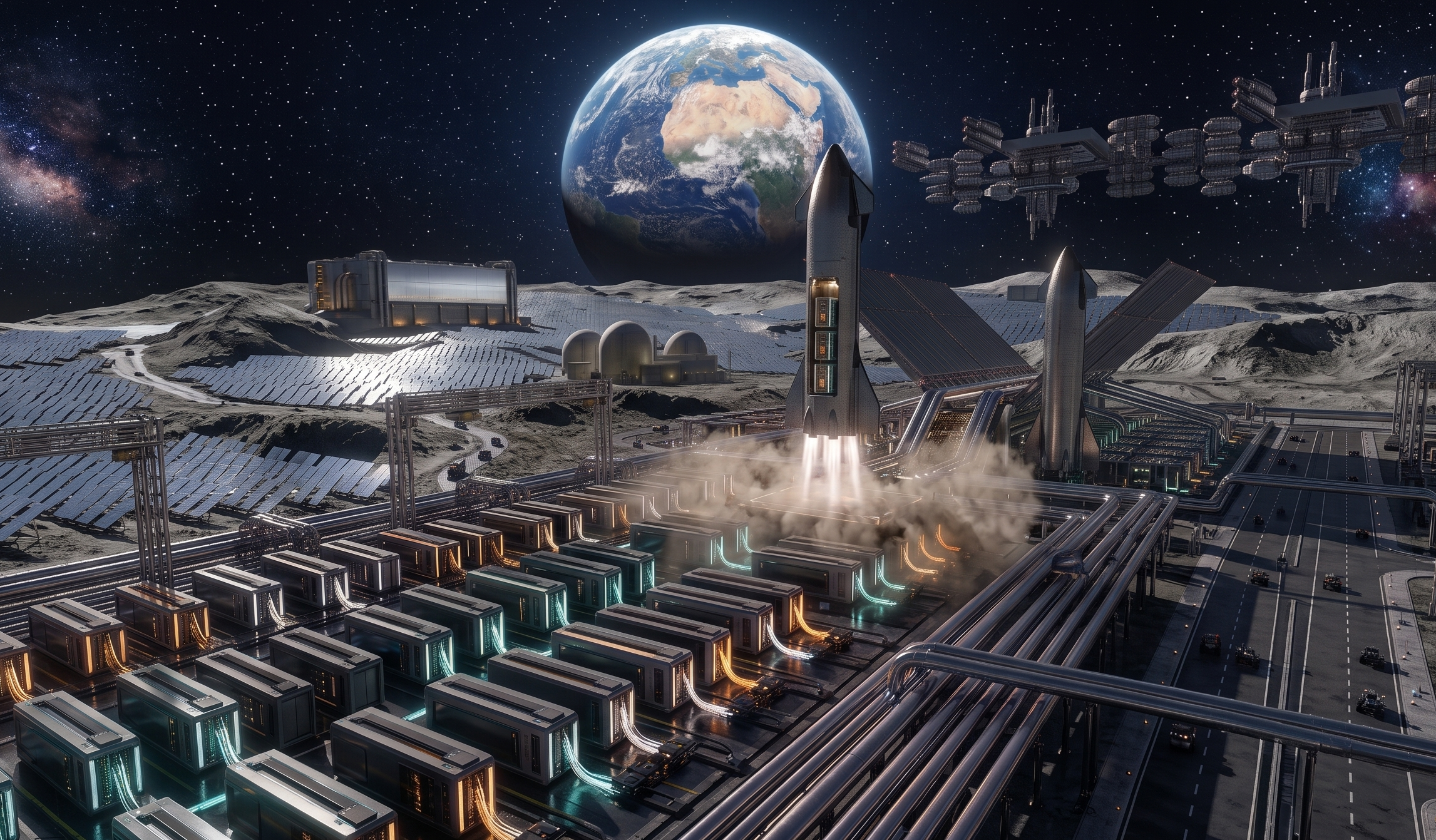
As this network of mass-manufactured compute pods expands outward, the Moon represents the ultimate destination for a Sovereign Data Center. It offers a place to train massive AI models far from Earth's crowded power grids or the terrestrial bottlenecks Meta is currently bypassing via orbital solar. In this off-world economy, Bitcoin remains the native way to pay. It is the only money that works perfectly in space, allowing for the transfer of Bitcoin between Earth and the lunar surface without the need for a central bank. This off-world compute capability adds a new layer of security for wealth that seeks to remain outside traditional geopolitical risks.
Navigating the Silicon Reserve
The silicon and Bitcoin trade represents a fundamental departure from legacy asset allocation. Bitcoin is a highly liquid asset that trades 24/7. Meanwhile, the output of an AI foundry or a lunar data center is a physical commodity with global demand. The world is moving away from paper wealth and toward physical proof. This structural shift requires a proactive assessment of how to be positioned for the re-industrialization of the global economy, both on and off-planet. For the clients of a modern wealth management firm, the ultimate goal is to own the foundational infrastructure that converts joules into the future.
For tech founders and employees with concentrated wealth in aerospace or AI, the SpaceX IPO creates a unique and immediate financial challenge. With the company eclipsing its $1.77 trillion initial baseline and trading above a $2.1 trillion market capitalization, many individuals are facing massive, highly concentrated equity positions in the very infrastructure that defines this new era. While it is tempting to hold 100 percent of a Silicon Reserve asset, prudent wealth management requires balancing that exposure with strategic diversification.
The end of a reserve currency’s dominance is not a sudden crash, but a slow move toward more durable forms of value. History consistently rewards those who recognize these tectonic shifts early. Projects like Terafab are about building advanced semiconductors, but they are also about owning the sovereign ability to generate intelligence. Similarly, Bitcoin mining is about securing immutable truth through energy.
The goal for any investor is to locate the point of maximum structural leverage. Today, that leverage exists where the hardware that thinks (flops) meets the hardware that counts (Bitcoin). By moving toward these thermodynamic hard assets, wealth can be protected not just from currency debasement, but from the obsolescence of the legacy world. The Terafab and the Bitcoin mining rig are two sides of the same machine: one produces the future, while the other ensures it can be trusted. At Citrine, our proactive research into money, energy, and compute infrastructure ensures that we are positioned for tomorrow's realities. The winners will be those who understand the physics of truth before the rest of the market.
Investor Takeaways:
The Thermodynamic Floor: Enterprise Bitcoin infrastructure acts as a flexible base load and instant, global energy buyer. This creates an immediate economic floor that de-risks the massive, multi-year upfront capital requirements of building terrestrial AI foundries.
The Sovereign Compute Mandate: Tectonic developments like the SpaceX IPO and the 100 TW orbital compute incentives reveal a rapid transition toward a "Silicon Reserve" framework. This shifts intensive workloads off-planet to bypass terrestrial gridlock and bureaucratic approvals.
Physical Proof Over Paper Wealth: As legacy reserve currencies face unprecedented debt loads, the financial world is splitting. Long-term wealth preservation requires moving away from inflationary paper assets and directly into the hardware that thinks (Flops) and the hardware that counts (Bitcoin).
About The Author
Jirayr Kembikian, CFP® is a wealth advisor, managing director and co-founder of Citrine Capital, a San Francisco-based wealth management and tax preparation firm serving tech professionals, founders, and business owners. He specializes in navigating the complexities of equity compensation, private investments, and Bitcoin wealth strategies. With over a decade of experience guiding clients through liquidity events and complex financial decisions, Jirayr brings a grounded yet forward-thinking perspective to building and preserving wealth.